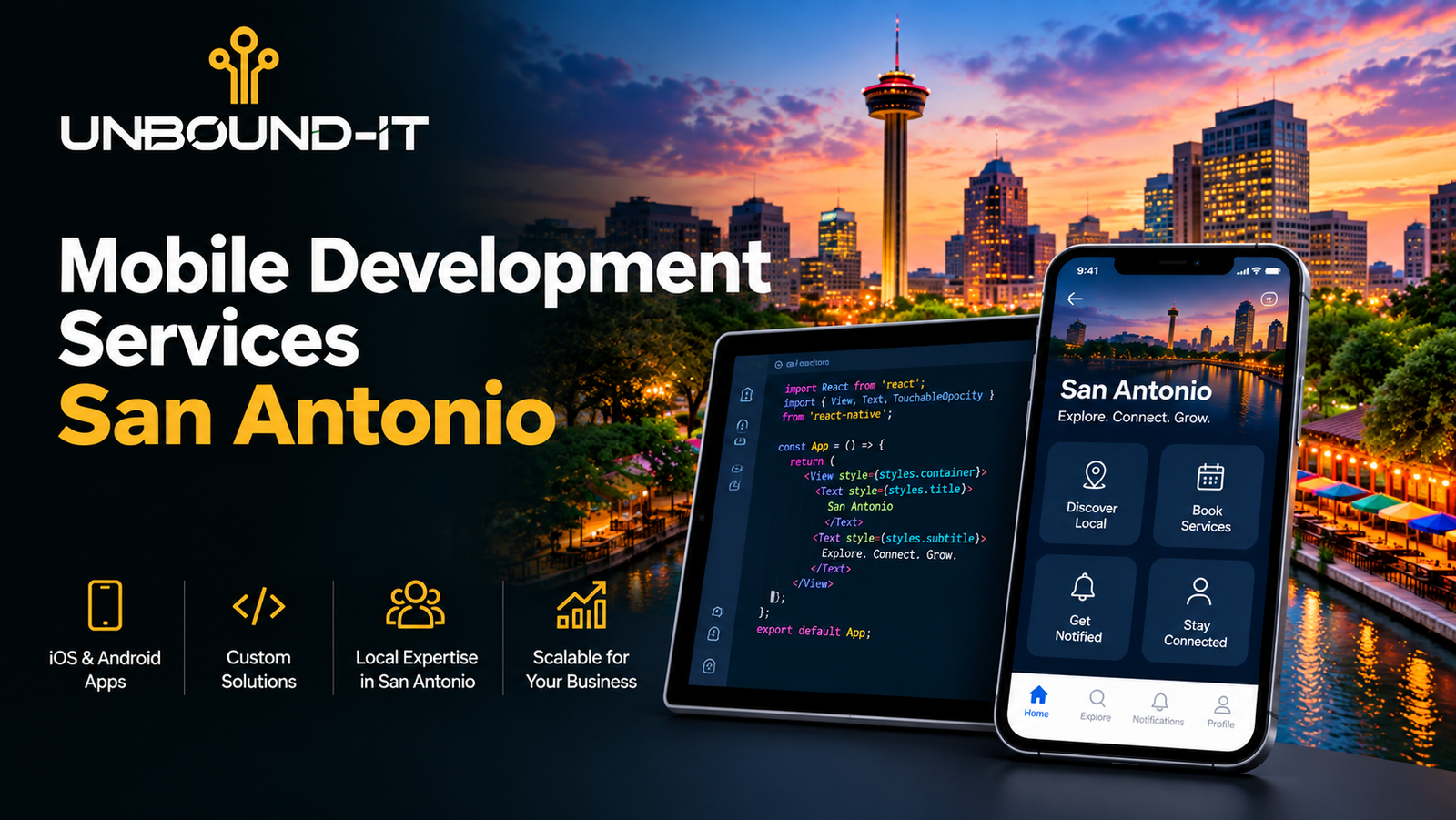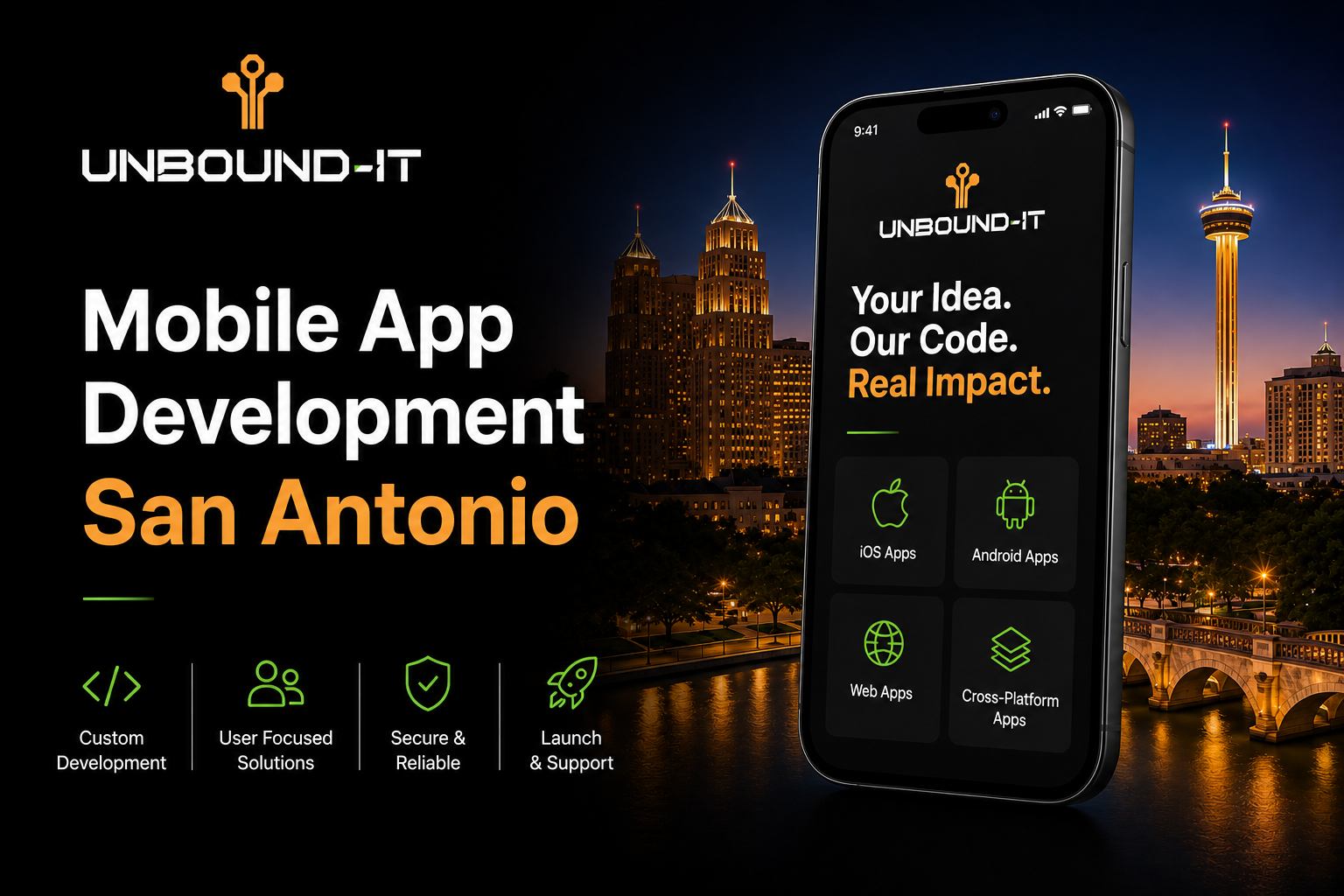
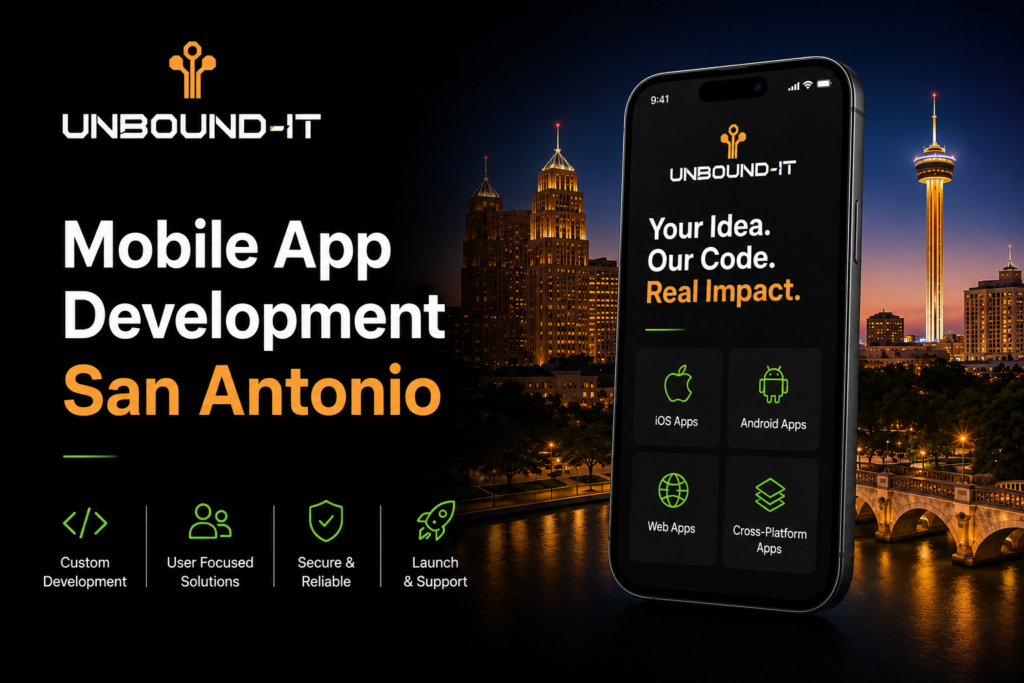
If you have been searching for mobile app development in San Antonio, you already know what you need. You are not looking for a general explanation of what an app can do for your business. You are looking for a development partner who can take your idea, or your outdated app, and turn it into something customers actually use. This guide covers what separates a strong mobile app development company from an average one, what the process actually costs, and why local businesses across San Antonio are choosing Unbound IT to build their apps.
Why San Antonio Businesses Are Turning To Custom Mobile Apps
Mobile apps stopped being optional years ago. The market backs this up. Global spending on mobile apps is projected to reach nearly seven hundred forty billion dollars in 2026, with the United States accounting for the largest share of that revenue at over three hundred billion dollars, according to Statista’s App market forecast. That is not a niche market. It is where a growing share of customer attention and spending already lives.
San Antonio has become part of that shift in a real way. The city’s tech and startup scene has matured over the past decade, with organizations like Geekdom, Tech Bloc, and Port San Antonio helping local companies build and scale software products that used to require a move to Austin or Dallas. As San Antonio Report’s coverage of the city’s startup ecosystem notes, San Antonio’s strengths in cybersecurity, healthcare, and applied technology are drawing more founders and more investment into locally built software, including mobile products.
For an established business, this means your customers already expect a mobile experience. They expect to book, order, schedule, pay, or track a service from their phone, not just browse a website that describes what you do. A business that has not made this move is handing that convenience to a competitor who has.
What To Look For In A Mobile App Development Company
Not every development shop is equipped to take a project from concept to a live app on the App Store and Google Play. Before you commit budget to a team, it is worth understanding the three things that actually determine whether your app gets built correctly and on time.
Technical Skill Across iOS And Android
Apple and Google each maintain their own submission requirements, and both have tightened their review standards in recent years. Apple’s App Store Review Guidelines cover safety, performance, business practices, and design, and an app that ignores them gets rejected during review, which delays your launch. Google applies a similar standard through its Play Store developer policies. A development company that understands these requirements before writing a single line of code saves you weeks of back and forth during submission.
A Process That Fits Your Timeline And Budget
A mobile app is not a single deliverable. It is a sequence of decisions, discovery, design, development, testing, and launch, and each stage affects the next. A development partner who cannot walk you through that sequence in plain language, with real milestones attached, is not ready to manage your project.
Local Availability And Communication
Offshore and remote-only teams can build a functional app, but when something needs to change quickly, or a stakeholder wants to sit down and walk through a decision, time zone gaps and language barriers slow everything down. A San Antonio based team that can meet in person, understands the local business environment, and answers the phone when you call removes that friction entirely.
Common Mistakes Businesses Make When Choosing A Mobile App Development Company
Business owners who have never built an app before tend to make the same handful of mistakes, and most of them are avoidable with the right information going in.
Choosing The Lowest Bid Instead Of The Right Fit
The cheapest quote almost always means the least amount of planning, the fewest testing cycles, or a template-based build that looks custom but is not. A low upfront price often turns into a much higher total cost once bugs surface after launch or the app needs to be rebuilt to support a feature it was never designed to handle.
Skipping The Discovery Phase
Some agencies want to jump straight into design because it feels like progress. Without a real discovery phase, where the team maps out your actual business process and customer journey, the app ends up solving the wrong problem. This is one of the most expensive mistakes a business can make, because it usually is not obvious until months into development.
Ignoring The Maintenance Plan
Apple and Google both push operating system updates every year, and an app that is not maintained will eventually break, get flagged during a routine review, or simply stop functioning correctly on newer devices. A development company that does not talk to you about post-launch support during the sales process is not planning for your app’s long-term health.
Native, Hybrid, Or Cross-Platform: Making The Right Call
One of the first technical decisions in any project is how the app gets built. Native development means building separate versions for iOS and Android using each platform’s own tools, which delivers the best performance and the deepest access to device features. Cross-platform frameworks like Flutter and React Native let a team build once and deploy to both platforms, which usually costs less and moves faster, though it can involve small trade-offs in performance for highly graphics-intensive apps.
Neither option is universally correct. A retail app that needs fast, polished animations and deep integration with device hardware might justify native development. A service-based business that needs a clean booking and account experience across both platforms is often better served by a cross-platform build that gets to market faster and costs less to maintain. The right development company will make this recommendation based on your actual goals, not based on what is easiest for them to sell.
What Mobile App Development Actually Costs In San Antonio
Cost is usually the first question business owners ask, and it is a fair one. According to Clutch’s pricing data on app development projects, most agency-built apps fall between ten thousand and fifty thousand dollars, with the average full project landing around ninety thousand dollars depending on complexity, platform choice, and the number of custom features involved.
A simple app with basic functionality, such as a digital menu, a booking form, or a loyalty program, sits toward the lower end of that range. An app that needs user accounts, payment processing, real-time data, or integration with your existing business systems will cost more because there is simply more engineering work involved. The honest answer is that cost follows scope, and any company that gives you a firm number before understanding what you actually need is guessing.
What matters more than the sticker price is what you get for it. An app built without a clear technical foundation often needs to be rebuilt within a year or two, which means the business ends up paying twice. A properly scoped app built by a team that plans for growth from the start costs more upfront but saves money over the life of the product.
Beyond the build itself, budget for ongoing maintenance. Industry data consistently shows maintenance running about fifteen to twenty percent of the original build cost each year, covering operating system compatibility updates, bug fixes, and security patches. Businesses that skip this line item often end up with an app that quietly stops working for a segment of users and do not find out until customers start complaining.
Why Unbound IT Is The Mobile App Development Company San Antonio Businesses Trust
Unbound IT builds mobile apps for businesses across San Antonio and beyond, and our process is built around one goal: shipping an app that actually gets used, not just one that gets approved by the app stores and forgotten. Our development work is closely tied to the same technical foundation we bring to every project, including the web design and development work we do for clients who need their app and their website working together instead of as two disconnected systems.
Discovery And Planning
Every project starts with a conversation about your business, not your app. We want to understand who your customers are, what they are trying to accomplish, and where your current process breaks down. From there we map out the features that matter and the ones that can wait, so your budget goes toward what actually moves the needle.
Design And Development
Once the scope is set, our team designs the interface around how your customers actually behave on a phone, then builds the app using the platform approach that fits your goals, whether that is native, cross-platform, or a hybrid model. You see working versions of the app throughout development, not just a finished product at the end.
Testing, Launch, And App Store Submission
Before anything goes live, we test across real devices and operating system versions, not just simulators. We handle the App Store and Google Play submission process directly, including the metadata, screenshots, and compliance details that cause most first-time submissions to get rejected.
Ongoing Support After Launch
An app is not finished the day it launches. Operating systems update, devices change, and your business needs evolve. Our IT support and managed services team keeps your app running, monitors performance, and handles updates so you are not stuck fielding support calls about a broken feature six months after launch.
What Working With Unbound IT Looks Like In Practice
A San Antonio service business we worked with had spent years relying entirely on phone calls and a basic contact form to book new customers, and staff were spending hours each week just managing scheduling conflicts. We built a custom app that let customers book, reschedule, and pay directly from their phone, connected to the same backend we set up as part of their broader SEO and digital presence work. Within the first two months, online bookings became the primary way new customers reached the business, and staff time spent on scheduling dropped significantly. That is the kind of outcome a mobile app should produce: less manual work for your team and a better experience for your customer.
Signs Your Business Is Ready For A Custom App
Not every business needs an app on day one, but there are clear signals that the timing has arrived. If your staff spends significant time each week on manual scheduling, order entry, or answering the same repetitive customer questions, an app can absorb that workload directly. If customers regularly ask whether you have an app, that demand is already telling you something. If your business relies on repeat visits or ongoing engagement, such as a loyalty program, a subscription, or recurring appointments, an app gives you a direct channel to that customer instead of competing for their attention through email or social media, both of which are becoming harder to get in front of.
A useful gut check is to look at how your closest competitors operate. If competitors in your market already have an app and you do not, you are already behind on a channel your customers expect. If none of your competitors have made the move yet, that is an opportunity to establish yourself as the business that offers the most convenient way to do business, before someone else claims that position.
The Cost Of Waiting To Build Your App
Every month a business delays building its app is a month competitors have to establish themselves with customers who now expect a mobile-first experience. This is not about chasing a trend. It is about matching how your customers already behave. Someone who wants to book a service, order a product, or manage an account is increasingly doing that from a phone, and a business without an app is asking that customer to do more work than necessary just to become a paying customer.
The businesses that move now are building the customer habits and data advantages that become difficult for a competitor to catch up to later. A loyal customer using your app daily is far harder for a competitor to win over than one who has never had a reason to open it.
Ready To Build Your App? Here Is How To Start
The first step is a conversation, not a contract. Tell us what your business needs the app to do, and we will give you an honest assessment of scope, timeline, and cost before any work begins. If a native app is not the right fit for your budget or timeline, we will tell you that too. Our job is to build the right solution for your business, not the most expensive one.
Unbound IT works with businesses across San Antonio and the United States to design, build, and support mobile apps that turn into a real part of how customers interact with your business. Learn more about our full range of services on our about page or reach out to our team to start scoping your project. You can also call us directly at 210-973-4901.
Frequently Asked Questions
How much does mobile app development cost in San Antonio?
Most projects range from fifteen thousand to one hundred thousand dollars depending on complexity, platform choice, and features. A simple booking or ordering app costs less than a full platform with user accounts, payments, and custom integrations. We provide a fixed scope and price after an initial discovery call, so there are no surprises once development starts.
How long does it take to build a mobile app?
A straightforward app typically takes eight to twelve weeks from discovery to launch. More complex apps with custom backend systems or multiple integrations can take four to six months. We set milestones at the start of the project so you always know what stage the build is in.
Should my business build a native app or a cross-platform app?
It depends on what your app needs to do. If your app relies heavily on device hardware, camera features, or high-performance graphics, native development is usually worth the extra cost. If your priority is getting a clean, functional app to both iOS and Android users quickly and affordably, a cross-platform build is often the better business decision.
Do you help with App Store and Google Play submission?
Yes. We handle the full submission process for both platforms, including compliance with Apple’s App Store Review Guidelines and Google Play’s developer policies, so your app does not get delayed or rejected due to avoidable technical issues.
What happens after my app launches?
We do not disappear after launch day. Our team provides ongoing support, monitors app performance, and manages updates as new operating system versions roll out, so your app keeps working the way it did on day one.
Does Unbound IT only work with businesses in San Antonio?
Our home base is San Antonio, and we understand the local business landscape well, but we work with clients across the United States who want a development partner that is easy to reach and easy to work with.