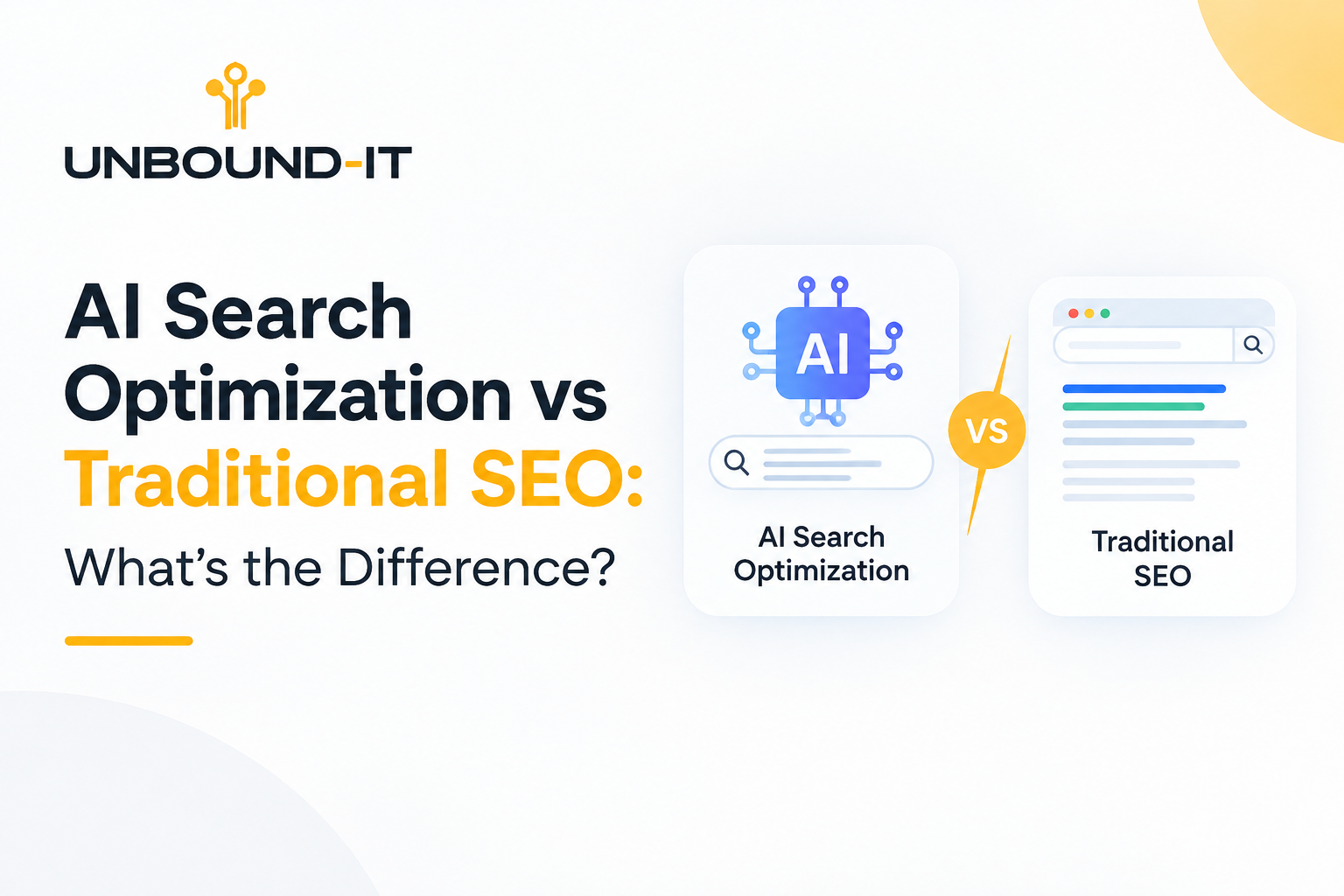
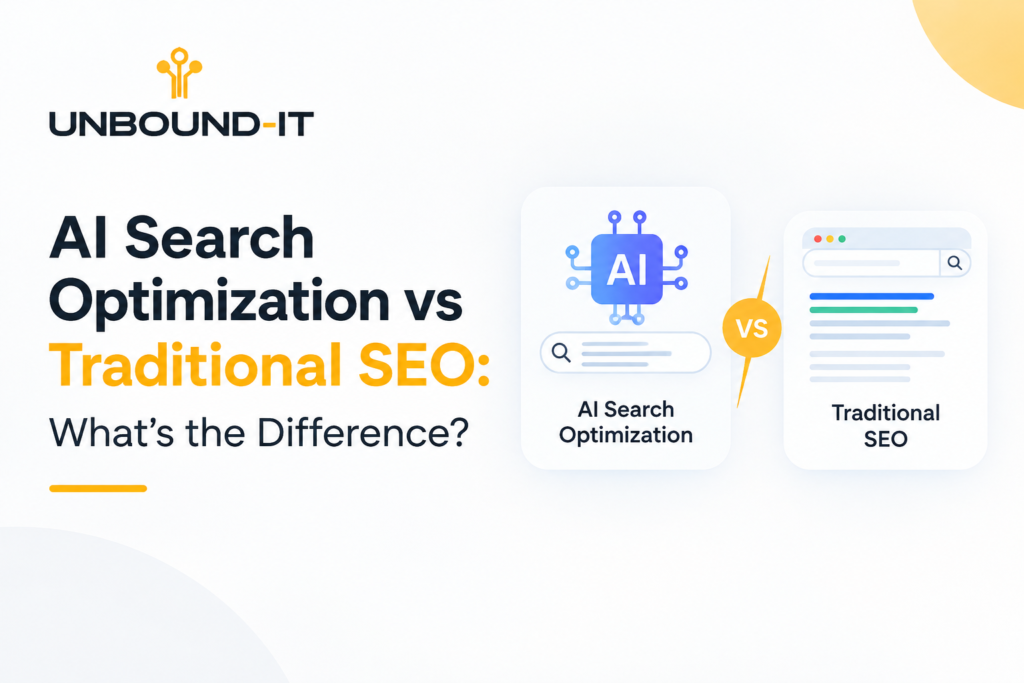
AI search optimization vs traditional SEO is the question marketing leads are asking before they approve this year’s budget, and the answer decides whether your spend shows up where buyers actually look. Traditional SEO earns a ranking and a click. AI search optimization earns a place inside the answer itself, as a cited source or a named recommendation, often before anyone visits a website. This guide explains how each one works, where they overlap, what each demands in time and money, and how to pick a partner who can handle both without selling you hype.
The Short Answer: Ranking Versus Being Cited
Traditional SEO is built around a results page. You choose keywords, build pages that match search intent, earn links, fix technical problems, and compete for a position in a ranked list. The reward is a click, and the click brings a visitor to your site where you can convert them.
AI search optimization is built around an answer. Google’s AI Overviews and AI Mode, ChatGPT search, Perplexity, and Microsoft Copilot take a question, gather material from several sources, and write one response. Your job is to be one of the sources they use and to be described accurately when they use you. The reward is visibility inside the response. It may or may not produce an immediate visit, but it shapes which brands a buyer remembers when they are ready to contact someone.
If you keep one distinction from this article, keep this one. Traditional SEO optimizes a page to rank. AI search optimization optimizes a passage, a fact, and a brand identity to be retrieved and trusted. Both rely on the same foundation, yet they reward different habits, and treating them as a single task is how companies end up paying for work that shows up in neither channel.
How Traditional SEO Works Today
Traditional SEO still produces most of the measurable organic demand for service businesses, and nothing about AI search has made it optional. It rests on four jobs. The first is technical access, which means search engines can crawl your pages, index them, and load them quickly on a phone. The second is relevance, which means each page answers a specific search intent better than the pages around it. The third is authority, built through quality backlinks, brand mentions, and a record of publishing reliable material. The fourth is experience, which covers usability, clarity, and trust signals such as real authorship and accurate contact details. Google’s own guidance on creating helpful, reliable, people-first content is still the best summary of what the ranking systems want.
Success is measured with rankings, organic sessions, and leads that came from organic search. That makes the channel easy to defend in a budget meeting. It also compounds, because a page that ranks keeps working long after it is published.
The weakness is an assumption baked into the model: that the searcher sees a list and chooses from it. When an AI summary sits above that list, a page ranking seventh may never be seen, and a page ranking first may be absent from the summary entirely. Rankings alone no longer tell you whether you are visible.
How AI Search Systems Choose Their Sources
To decide where to invest, you need to understand how these systems select material. The mechanics are simpler than most vendors make them sound.
Query Fan-Out Changes What Counts as Relevant
Google’s documentation explains that AI Overviews and AI Mode may use a technique called query fan-out, where the system issues multiple related searches across subtopics and data sources to build a response. In practice, one buyer question becomes many background questions. Someone asking which managed IT provider suits a 40-person company triggers lookups on pricing models, security practices, response times, and contract terms. A page that only targets the headline phrase loses to a site that covers the surrounding subtopics well. You can read the full explanation in Google’s AI features and your website guide.
Eligibility Starts With Ordinary SEO
The same Google guide states that to appear as a supporting link, a page must be indexed and eligible to be shown in Search with a snippet. It also says specific optimization is not required for these features, that the existing SEO fundamentals remain worthwhile, and that no special schema.org markup is needed. That matters for you as a buyer. If a vendor sells a secret tag, file, or tactic that unlocks AI Overviews, the platform’s own documentation says it does not exist.
Other Engines Use Their Own Crawlers
ChatGPT search relies on a crawler called OAI-SearchBot. According to OpenAI’s crawler documentation, sites that opt out of OAI-SearchBot will not be shown in ChatGPT search answers, though they can still appear as navigational links. GPTBot is a separate crawler tied to model training, and the two settings are independent. A business can allow search visibility while declining training use. Many companies block everything by accident through a blanket rule in robots.txt, then wonder why they never appear in AI answers.
Passages Matter More Than Pages
AI systems tend to lift a specific passage that answers a specific question. A strong 1,800-word page with its key answer buried in paragraph nine is harder to use than a shorter page that states the answer plainly under a clear heading. This is the biggest practical difference in how you write.
AI Search Optimization vs Traditional SEO: A Direct Comparison
Goal. Traditional SEO aims for position and traffic. AI search optimization aims for citation, accurate brand description, and inclusion in recommendation-style answers. A business can win one and lose the other, so you need to set a target for each.
Unit of work. In traditional SEO the unit is the page. In AI search the unit is the passage, along with the entity behind it, meaning your company, its services, its locations, and its people as the machine understands them. Inconsistent details across your website, Google Business Profile, LinkedIn, and directories weaken that understanding.
Queries. Classic SEO targets short phrases with measurable volume. AI search handles longer, conversational questions with context, such as a buyer describing their company size, budget, and constraints in a single sentence. Keyword research still helps, but you also need to collect the real questions your sales team hears.
Authority signals. Backlinks remain important for ranking. For AI answers, independent mentions matter as well, because systems that synthesize information look for corroboration across several sources. Reviews, industry listings, press, and consistent third-party descriptions of what you do all contribute.
Content format. SEO content can be long and still win. AI-ready content needs the same depth but with answer-first paragraphs, specific facts, named sources, and clear structure so a system can extract a clean statement without distorting it.
Measurement. SEO has mature tools and a decade of benchmarks. AI visibility is newer, noisier, and partly manual. Expect to combine platform reports with your own testing, which the measurement section below covers.
Speed of feedback. Rankings move on a familiar schedule. AI answers can change from one day to the next, and the same question can produce different sources on different runs. Plan for trends, not single snapshots.
Where the Two Disciplines Overlap
Most of the work is shared, which is good news for your budget. A site that cannot be crawled, loads slowly, or hides its content behind scripts that bots cannot render will fail in both channels. Clean architecture, fast pages, accurate titles and headings, and strong internal links benefit rankings and retrieval equally. If your site has structural problems, fixing them is the highest return task before anything labeled AI. Our website development and design team handles that foundation, including performance, mobile layout, and crawl-friendly builds on WordPress, Shopify, and custom stacks.
Helpful content is the other shared requirement. Pages written by people with real experience, with original detail and honest scope, serve searchers and AI systems alike. Thin pages produced at volume do not survive either one.
What Changes in the Content You Publish
Start each important section with the answer, then support it. If a heading asks what managed IT costs, the first sentence under it should state what drives the cost, not warm up to the topic. This habit helps readers and gives retrieval systems a clean passage to use.
Use specifics. Name the tool, the standard, the timeframe, the location, and the number. Vague copy cannot be cited because there is nothing concrete to cite. When you reference a statistic or a rule, link to the primary source, as we have done throughout this article.
Publish information others do not have. Pricing ranges with the factors behind them, process timelines, comparison pages, original survey results, and case outcomes give a system a reason to choose your page over ten similar ones. Commercial pages deserve the most attention, since those are the ones tied to revenue. A buyer comparing providers wants evidence, and the pages that supply it are the ones that get cited.
Keep your entity details identical everywhere. Business name, address, phone number, service descriptions, and leadership bios should match across your site and every profile. For local businesses this is critical, and it is a core part of how a San Antonio SEO company should audit your presence before touching a single page.
Finally, show authorship and dates. Named authors with real credentials and visible updated dates signal that the content is maintained and accountable. Outdated pages are quietly dropped when systems have fresher alternatives.
Technical Setup for AI Visibility
Begin with access. Confirm that Googlebot can crawl and render your key pages, that none of them carry a noindex directive by mistake, and that your snippet settings do not block previews, since Google ties eligibility to being shown with a snippet. Then review robots.txt for your intended rules on OAI-SearchBot, GPTBot, and any other crawler you care about. Decide deliberately which crawlers you allow, and write the rules to match that decision rather than inheriting a template.
Next, make sure the important content is present in the rendered HTML and not locked behind interactions that a crawler will not trigger. Tabs, accordions, and lazy-loaded sections are common culprits.
Structured data is still worth adding, because it removes ambiguity about who you are and what a page covers. Organization, LocalBusiness, Service, Article, and Product markup are the usual choices, and Google’s introduction to structured data explains the supported types. Treat markup as clarification, not as a ranking lever, and do not expect it to force a citation.
Security belongs on this list too. A site flagged for malware or running without HTTPS loses trust with search engines and visitors, which is one reason we pair SEO work with cybersecurity services for clients who need both.
How to Measure Results in Both Channels
For classic SEO, keep using Search Console, analytics, and rank tracking, and tie organic sessions to leads in your CRM. For AI visibility, you now have an official starting point. On June 3, 2026, Google announced dedicated Search Generative AI performance reports in Search Console. They show how often your URLs appeared in generative AI features in Search and Discover, with views by page, device, and date. That data is also included in the overall Performance report, so your existing totals stay intact. At launch the reports covered impressions only, so you still need other signals to judge business impact.
Add your own testing. Build a list of 25 to 40 questions your buyers actually ask, run them monthly across Google AI Mode, ChatGPT, Perplexity, and Copilot, and record whether your brand is cited, how it is described, and which competitors appear beside you. Save the answers so you can compare trends over time.
Watch downstream signals as well. Branded search volume, direct visits, and the answers prospects give to a simple how did you hear about us question will show effects that no dashboard captures. Your server logs will also show whether crawlers such as OAI-SearchBot are visiting at all.
Which One Should You Invest in First?
The right order depends on where your business stands today.
If your site is new, slow, or poorly structured, start with traditional SEO fundamentals. Nothing else works until pages are indexed, fast, and clear. Spending on AI-specific tactics before that point wastes money.
If you already rank for important terms but see impressions holding steady while clicks decline, add the AI search layer now. That pattern often means answer summaries are absorbing informational queries. Your priority is restructuring key pages for extraction, strengthening third-party corroboration, and protecting the commercial pages that still convert.
If you run a local service business, treat the two as one program built around your entity and your reviews. Accurate profiles, consistent listings, and location pages with real substance serve both channels.
If you sell to businesses with long evaluation cycles, lean harder into AI search. Buyers in that group do much of their early research through conversational tools, and shortlists are often formed before anyone fills out a form. Being named in those answers puts you on the list.
For most companies the practical answer is a sequence, not a choice. Fix the foundation, then restructure the pages that sell, then build the corroboration that earns citations.
How to Evaluate an SEO Provider for AI Search
You can separate serious providers from opportunists with a handful of questions. Ask what they audit first. A credible answer starts with crawlability, indexation, and content quality on your revenue pages, not with a list of AI tools.
Ask what they will guarantee. Nobody can promise placement in AI answers, because the systems are probabilistic and controlled by the platforms. A provider who guarantees citations is either misinformed or misleading you.
Ask how they report. You should receive Search Console data including the new generative AI reports, structured prompt testing results, and lead data, all tied to business outcomes. Vanity metrics like total impressions with no link to leads are a warning sign.
Ask who writes the content. Pages that reference real processes, real tools, and real outcomes need subject knowledge. Generic text produced at volume is exactly what retrieval systems have little reason to cite.
Ask whether they can implement fixes or only recommend them. Technical gaps found in an audit sit unresolved when the agency has no development capacity. A team that handles strategy, development, and content together closes the loop faster. That is the model behind our digital marketing and SEO services, where audits connect directly to builds and publishing.
What It Costs and What Drives the Price
Prices vary widely, so any single figure quoted without context should make you cautious. Several factors set the real cost. Site size and technical debt come first, since a clean 30-page site and a 3,000-page store with duplicate content are different projects. Competition in your market sets how much content and authority building you need. The number of locations and services multiplies the pages and profiles to maintain. The depth of reporting, whether you want prompt testing across several AI platforms or only Search Console summaries, changes the hours involved. Finally, whether design and development are included or handled separately affects the total.
Structure also matters. A one-time audit and fix project suits companies with a capable in-house team. An ongoing retainer suits companies that need steady publishing, monitoring, and adjustment. Ask for scope in writing, including deliverables per month, reporting cadence, and what happens if the platforms change their rules mid-contract.
On timing, technical fixes can show effects within weeks once pages are recrawled. Authority and citation gains build over months. Be skeptical of anyone promising fast results in a channel that rewards accumulated trust.
A Practical 90-Day Plan
The first month is for diagnosis and repair. Run a full crawl, resolve indexation and speed problems, review robots.txt for deliberate crawler rules, and verify your Search Console property so the new AI reports are available. Build your baseline question list and record where you appear today.
The second month is for the pages that sell. Rewrite your service, pricing, and comparison pages with answer-first structure, specific details, named sources, and clear authorship. Add structured data that matches what is visible on the page. Fill gaps that your question list exposed, especially subtopics that fan-out queries are likely to touch.
The third month is for corroboration and measurement. Clean up every business profile so details match, pursue reviews and relevant industry mentions, and publish at least one piece of original information others can cite. Re-run your question list, compare it to the baseline, and review the Search Console AI data alongside organic leads. Use what you learn to set priorities for the next quarter.
Work With Unbound-IT on Both
Unbound-IT is a San Antonio, TX company that combines web development, digital marketing, cloud, and cybersecurity under one roof, which means the technical fixes behind good search visibility do not wait in a queue for another vendor. Our digital marketing services cover SEO, content, and paid channels, and our team can audit your current site against both traditional ranking factors and AI retrieval readiness. You can learn more about who we are on our About Us page.
If you want a clear read on where your site stands, contact us for a consultation. Call 210-973-4901 or email info@unbound-it.com, and tell us your market, your top revenue pages, and the questions your buyers ask. We will tell you what to fix first and what it should take.
Frequently Asked Questions
Is AI search optimization replacing traditional SEO?
No. Google states that existing SEO fundamentals remain worthwhile for AI Overviews and AI Mode, and a page must be indexed and eligible for a snippet to appear as a supporting link. AI search optimization builds on SEO rather than replacing it.
Do I need different keywords for AI search?
You still need keyword research, but you also need the full questions buyers ask, including the context they add. Conversational queries tend to be longer and more specific, so pages should cover related subtopics, not just one phrase.
Are GEO, AEO, and AI search optimization the same thing?
The labels overlap heavily. Generative engine optimization, answer engine optimization, and AI search optimization all describe making your content and brand easier for AI systems to retrieve, understand, and cite. The tactics are largely the same regardless of the name.
Can anyone guarantee my brand will appear in ChatGPT or Google AI answers?
No. These systems are controlled by the platforms and can return different sources for the same question on different days. A responsible provider improves your eligibility and corroboration, then measures the outcome without promising placement.
How long does it take to see results?
Technical improvements can register within weeks after pages are recrawled. Gains from authority and consistent third-party mentions usually take several months. Track trends across a quarter instead of reacting to individual days.
Does schema markup get me into AI Overviews?
Not by itself. Google says no special schema.org structured data is required for AI features. Markup still helps clarify what your pages and business are about, so it is worth implementing accurately.
Should I block AI crawlers?
That depends on your goals. Blocking OAI-SearchBot removes your site from ChatGPT search answers, while blocking GPTBot only addresses training use. Google has also begun testing a Search Console control for AI features. If visibility is the goal, allow the search crawlers and make the decision on training separately.