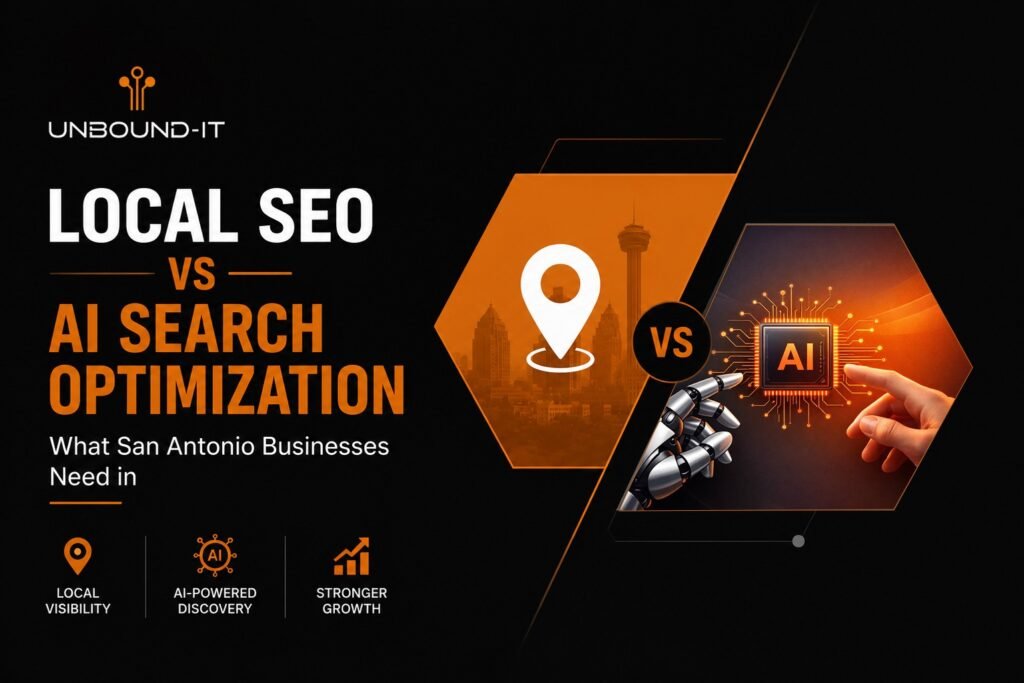
Local SEO vs. AI search optimization is no longer a theoretical debate for San Antonio business owners. It is a budget decision you are making right now, whether you realize it or not. Every dollar you put into ranking on Google Maps is a dollar not spent making sure ChatGPT, Gemini, and AI Overviews mention your business by name. And every dollar spent chasing AI citations is a dollar not spent on the reviews, listings, and local pages that still drive the majority of calls for service businesses in this city.
The honest answer is that you do not get to choose one over the other anymore. But you do need to understand what each one actually does, where they overlap, and where they pull in different directions, so you spend your marketing budget on the right thing at the right time instead of guessing.
What Local SEO Actually Means in 2026
Local SEO is the set of signals that determine whether your business shows up in Google’s Local Pack, in Google Maps, and in the organic results when someone searches for a service “near me” or in a specific San Antonio neighborhood. It is built on three pillars that Google has used for years: relevance, distance, and prominence.
Relevance means your Google Business Profile and website clearly state what you do. Distance means how close you are to the person searching. Prominence is a mix of reviews, backlinks, citations, and how well known your business is online. None of this is new. What has changed is how much weight each piece carries and how fast the competitive bar is moving.
Reviews now function as both a trust signal for customers and a ranking signal for Google. Businesses that consistently generate new reviews, not just a stockpile from three years ago, are outperforming competitors who let their profile sit untouched. Recent Semrush research on local ranking factors shows businesses ranking in Google’s Local Map Pack carry an average of nearly 1,000 backlinks, which tells you local rankings are not won by a Google Business Profile alone. They require a website with real authority behind it.
Mobile behavior is the other piece that makes local SEO non-negotiable for a market like San Antonio. Google has reported that the majority of people who perform a local search on their phone visit a business within a day of that search. That is not a browsing audience. That is someone deciding, in the next few hours, which business gets their money.
What AI Search Optimization Actually Means
AI search optimization, sometimes called generative engine optimization or GEO, is the practice of structuring your content so that AI systems like Google’s AI Overviews, ChatGPT, Gemini, and Perplexity can read it, trust it, and use it to answer a question directly, often without the user ever clicking through to your site.
This is a fundamentally different game than traditional SEO. Traditional SEO optimizes for a ranking position on a results page. AI search optimization optimizes for being the source an AI model pulls from when it writes its own answer. Your website is not competing for a blue link anymore. It is competing to be the raw material an algorithm uses to generate a paragraph.
The scale of this shift is no longer up for debate. Google has publicly confirmed that AI Overviews now appear on roughly half of all US search queries, a jump from under 7 percent at the start of last year. Independent research shows AI Overview coverage varies heavily by industry and by how long and specific the search query is, with question-based searches triggering an AI summary far more often than short, generic ones.
The consequence for your traffic is direct. Position-one organic listings that used to earn close to 40 percent click-through rates on a clean results page see that number cut roughly in half when an AI Overview sits above them. Fewer people are clicking through ten blue links. More people are reading one AI-generated answer and deciding based on that alone. If your business is not the source behind that answer, you are invisible at the exact moment someone is ready to choose.
Where Local SEO and AI Search Optimization Overlap
Here is the part most agencies do not explain clearly. Local SEO and AI search optimization are not two separate disciplines fighting for budget. They share the same foundation, and that foundation is accurate, structured, trustworthy information about your business.
An AI system deciding whether to cite your plumbing company for a “best plumber San Antonio” query is looking at many of the same signals Google’s Local Pack algorithm has used for years. Is your business name, address, and phone number consistent across the web. Do you have recent, substantive reviews. Does your website clearly and specifically describe the service being asked about, rather than using vague language about being a trusted partner in excellence.
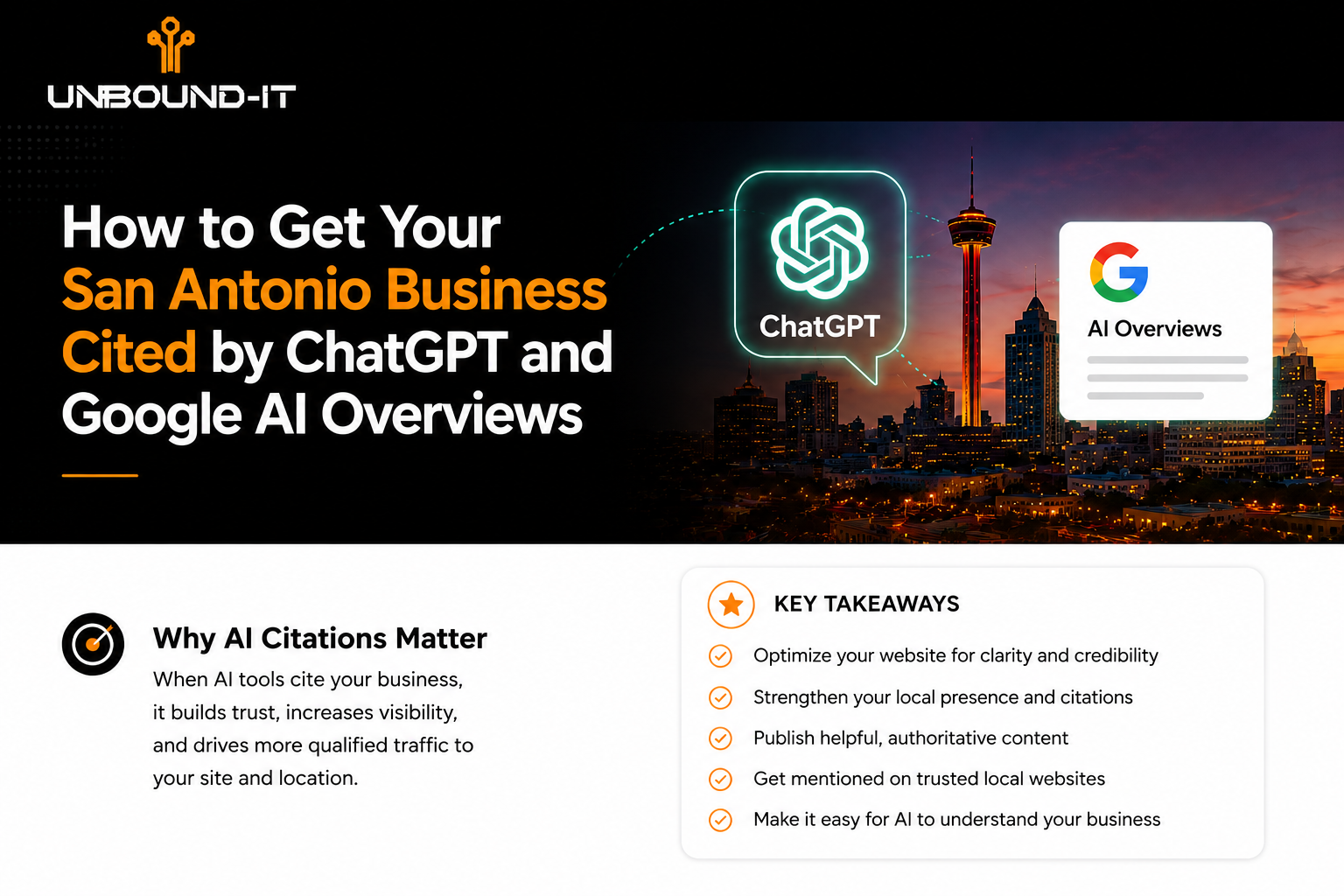
Research from local SEO firm Locafy found that Google’s own AI surfaces, meaning AI Overviews and AI Mode combined, cite local businesses more often than ChatGPT and Copilot combined. That single finding should reshape how you think about this decision. If you have already invested in local SEO fundamentals, correctly structured Google Business Profile, strong reviews, consistent citations, you already have a meaningful head start on AI search visibility. The businesses starting from zero on both fronts are the ones falling furthest behind.
Where the two disciplines diverge is in content strategy. Local SEO rewards location pages, service area pages, and citation building. AI search optimization rewards content that answers a specific question completely, in a format an AI model can parse and extract cleanly, often using clear headers, direct answers near the top of the page, and language that matches how people actually ask questions out loud or type them into a chat window.
What Happens When You Only Invest in Local SEO
A lot of San Antonio businesses are still operating exactly the way they were three years ago. Optimize the Google Business Profile, collect reviews, build a few citations, and call it done. That approach still works for showing up in the Local Pack. It does almost nothing for AI search visibility.
The gap shows up specifically on longer, question-based searches, the kind that increasingly trigger an AI Overview instead of a traditional Local Pack. Pew Research Center found that AI summaries appeared in 60 percent of searches that started with question words like who, what, when, or why. If your website only has thin, generic service pages and no content that actually answers the questions your customers are asking, you can rank in the Local Pack and still be completely absent from the AI answer sitting above it.
This is the trap. Local Pack visibility feels like proof you are winning. Meanwhile a growing share of searches never reach the Local Pack at all because the AI Overview answered the question first.
What Happens When You Only Invest in AI Search Optimization
The opposite mistake is just as costly, and we see it from newer, more aggressive marketing agencies pitching AI search as the only thing that matters now. If you optimize purely for AI citations and neglect your Google Business Profile, your review velocity, and your local citations, you lose the Local Pack entirely, and the Local Pack still drives the overwhelming majority of local commercial searches that have not shifted to AI summaries yet.
Local search still makes up close to half of all Google queries, and a large share of those searches are still resolved through the traditional map and three-listing format, not an AI Overview. A roofing company that builds beautifully structured, AI-friendly content but ignores its Google Business Profile is leaving the single highest-converting piece of local real estate on the table.
Neither strategy alone is sufficient. The businesses winning right now in San Antonio are the ones treating this as one connected system, not two competing line items.
The Combined Strategy That Actually Works for 2026
Start With a Technical Foundation That Both Systems Can Read
AI systems and Google’s local algorithm both penalize slow, poorly structured websites. A site that takes more than three seconds to load on mobile is losing users before either system has a chance to evaluate the content on the page. Google’s own Core Web Vitals standards remain a direct, measurable factor in how a website is ranked, and that has not changed with the rise of AI search. If anything, technical performance matters more now, because AI crawlers need to efficiently parse your content, and a slow or poorly coded site makes that harder.
This is foundational work. Before you spend a dollar on content or citation building, your website development and design needs to be fast, mobile-first, and structured cleanly enough for both search engines and AI models to understand what you offer.
Build a Google Business Profile That Works Double Duty
Your Google Business Profile is not just a local SEO asset anymore. It is a primary data source AI models pull from when answering local queries. Data from Google’s own guidance on optimizing a Business Profile points to the same conclusion independent research keeps confirming: top-ranking profiles average around 250 reviews and images, with businesses in the Local Pack averaging close to 1,000 backlinks pointing to their site. That means your profile needs a specific, detailed business description, current photos, accurate categories, and a steady, consistent flow of new reviews, not a burst of reviews once a year followed by silence.
Write Content That Answers Real Questions, Not Content That Describes Your Company
This is the single biggest content shift required for AI search visibility. Generic pages about how great your company is do not get cited. Pages that directly and specifically answer a real customer question do. If someone in San Antonio is searching “how much does it cost to fix a slab leak” or “what is the average timeline for a bathroom remodel,” and your website has a clear, direct, well-structured answer to that exact question, you have a real shot at being the source an AI model quotes.
This is where a strong digital marketing and SEO strategy earns its budget. Not by publishing more content, but by publishing content mapped directly to the actual questions your customers type or speak into a search bar.
Fix the Trust Layer Both Systems Rely On
Inconsistent business information across directories confuses both Google’s local algorithm and the AI models scraping the web for citation-worthy sources. Your name, address, and phone number need to match exactly everywhere they appear. Your reviews need to be recent and substantive, not just star ratings with no detail. This trust layer is unglamorous work, but it is the difference between a business AI systems treat as a credible source and one they skip entirely.
Monitor Both Local Pack Rankings and AI Citation Presence
You cannot manage what you do not measure, and ongoing coverage from Search Engine Journal makes clear that most San Antonio businesses are still only tracking traditional keyword rankings. That leaves you blind to whether AI Overviews and AI Mode are actually citing your business when relevant questions come up. Tracking both local ranking position and AI citation frequency is now a baseline requirement, not an advanced tactic reserved for large enterprises.
How to Know Which One to Prioritize First
If your Google Business Profile is incomplete, your reviews are sparse or stale, or your business information is inconsistent across the web, fix that first. This is the fastest path to revenue and it is the same foundation AI search visibility depends on anyway. There is no version of AI search optimization that works if your local trust signals are broken.
If your local presence is already solid, meaning a complete profile, consistent citations, and a steady review cadence, but your website content is thin, generic, and does not answer real customer questions, that is where AI search optimization work should go next. You are leaving visibility on the table in the exact format more and more of your customers are using to make decisions.
Most businesses we evaluate in San Antonio fall into the first category. The good news is that fixing the local foundation is often faster and less expensive than a full AI content overhaul, and it pays off immediately in call volume while setting up the technical and trust groundwork that AI search optimization needs to succeed.
What This Actually Costs and What Return You Should Expect
Local SEO and AI search optimization are not one-time projects. They are ongoing work, and businesses that treat them as a single campaign with an end date consistently lose ground to competitors treating this as a permanent part of operations. That said, the investment scales to what your business actually needs. A technical audit and Google Business Profile overhaul is a smaller, faster win. Full content rebuilding across your core service pages, paired with an ongoing review and citation strategy, is a larger, longer-term commitment.
What you should expect in return is not vanity metrics. It is fewer unqualified calls, because customers who found you through a detailed AI-generated answer or a well-optimized local listing already understand what you do before they pick up the phone. It is faster load times and lower bounce rates, because the technical fixes required for AI visibility also improve the experience for every human visitor. And over time, it is a widening gap between your business and competitors who are still treating this as optional.
The businesses in San Antonio moving on this now are going to build a level of local and AI-search authority that becomes genuinely difficult for late movers to catch up to. The ones waiting for more certainty are going to spend significantly more to close that gap later.
Get Your Website Evaluated
Unbound IT works with businesses across San Antonio and the broader United States to build websites and local search strategies that perform in both traditional and AI-driven search. If you are not sure whether your biggest gap is local SEO, AI search visibility, or the technical foundation underneath both, that is exactly the kind of question a proper audit answers. Learn more about our full range of IT and digital marketing services, read more about our team on our about us page, or contact us to get a straight answer on where your website actually stands, and what fixing it would look like.
Frequently Asked Questions
Is AI search optimization replacing local SEO?
No. AI search optimization builds on top of local SEO fundamentals rather than replacing them. Most of the signals AI models use to decide which local business to cite, accurate business information, strong reviews, and clear service descriptions, are the same signals that have driven local SEO for years. Businesses that skip local SEO fundamentals and jump straight to AI content strategies are building on a weak foundation.
How long does it take to see results from AI search optimization?
It varies, but most businesses start seeing early signals, meaning AI Overview citations or improved local visibility, within two to three months of a technical and content overhaul. Full authority building, the kind that makes your business a consistently cited source, typically takes six months or longer, similar to traditional SEO timelines.
Does my Google Business Profile matter for AI search, or just Google Maps?
Both. Your Google Business Profile is a primary data source for Google’s own AI Overviews and AI Mode, and it also feeds into how other platforms and directories describe your business. Neglecting it does not just hurt your Local Pack ranking. It weakens your AI search visibility as well.
What is the single biggest mistake San Antonio businesses make with local SEO right now?
Treating the Google Business Profile as a one-time setup task instead of an ongoing asset. Businesses that stop collecting reviews, updating photos, and refining their service descriptions after the initial setup fall behind competitors who treat the profile as something to actively maintain every month.
Can a small local business realistically compete with larger companies in AI search results?
Yes, and often more easily than in traditional SEO. AI models tend to reward specific, detailed, locally relevant answers over generic corporate content, regardless of company size. A small San Antonio business with genuinely useful, specific content about its services often has a real advantage over a larger competitor publishing generic, templated pages.