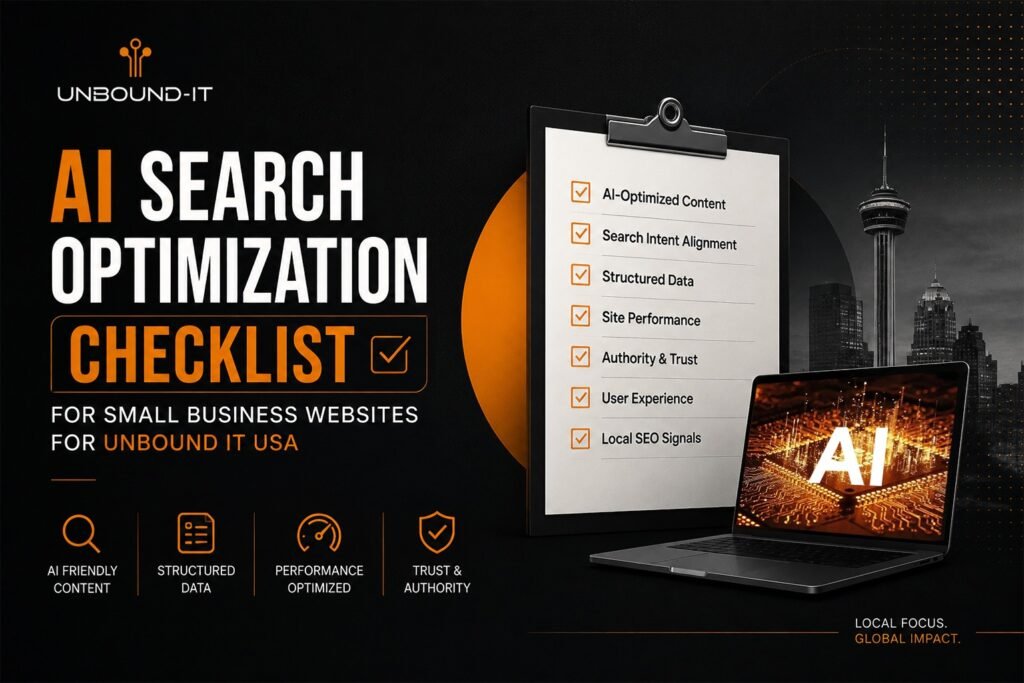
If your competitors are showing up in AI-generated answers and you are not, the problem usually comes down to a short list of fixable issues. This AI search optimization checklist for small business websites walks through exactly what to fix, in the order that gets results fastest, so you stop losing leads to businesses that simply built their websites the right way.
This is not a general overview of how AI search works. You already know that ChatGPT, Google AI Overviews, Gemini, and Perplexity are pulling answers from a small set of trusted websites and leaving the rest out. What you need now is the checklist that tells you what to fix first and why it moves the needle.
Small business owners are past the point of needing convincing that AI search matters. What most owners actually need is a working document they can hand to a web developer, a marketing contractor, or their own team and say fix these items in this order. That is what this checklist is built to be. Every item below is something you can verify yourself in a matter of minutes and something a competent developer can address within a few weeks, not a few quarters.
Why This Checklist Matters More Than Another Round of Blog Posts
Most small business owners respond to slow lead flow by publishing more content. That approach worked five years ago. It does not work now because AI search systems are not scoring you on volume. They are scoring you on speed, structure, clarity, and trust, then deciding whether your business deserves a mention in the answer a customer actually sees.
A checklist forces prioritization. Instead of guessing which page to update next, you work through a defined list of technical, content, and trust fixes that AI systems are actually evaluating. If you want a full breakdown of how AI-generated answers are chosen over traditional rankings, our team covers this in more depth on the Unbound IT blog, where we track what is changing in search behavior month to month.
There is also a cost problem that a checklist solves. Hiring an agency to reinvent your entire digital strategy from scratch is expensive and slow, and most small businesses do not need that. What they need is a targeted set of fixes applied to the pages that already exist. A checklist keeps the project scoped, keeps the budget predictable, and gives you a way to measure progress item by item instead of waiting months for a vague promise of better rankings.
How AI Search Actually Chooses Which Businesses to Show
AI systems are not ranking pages the way traditional search engines used to. They are summarizing information from a limited set of sources and citing the ones that meet a clear bar for quality and reliability. Google has documented this shift directly in its guidance on AI features and your website, which explains that the same fundamentals used for search ranking, technical health, clear content, and credible signals, also determine whether a page gets pulled into an AI-generated answer.
Performance is measured directly through Core Web Vitals, a set of load speed and stability metrics that Google uses to judge whether a page delivers a usable experience. A slow, cluttered site does not just rank lower. It gets skipped entirely when an AI system is deciding which handful of sources to cite.
There is a second layer to this that catches most business owners off guard. AI systems are not just reading your homepage. They are piecing together an understanding of your business from every page that is indexed, from your service pages to your about page to your location pages. A business with three thin pages and a slow homepage gives an AI system almost nothing solid to summarize. A business with clear, specific pages across its site gives the system multiple angles to pull from, which increases the odds of being cited across a wider range of customer questions.
This is why a checklist approach works better than chasing a single ranking factor. AI search visibility is the sum of many smaller signals working together, not one switch you flip. Fix the speed issue and the content issue and the trust issue at the same time, and the combined effect is far larger than fixing any single one of them in isolation.
The Complete AI Search Optimization Checklist for Small Business Websites
Work through each item below in order. Every item on this checklist addresses a specific reason AI systems either include or exclude a small business website from the answers customers see.
1. Audit Your Core Web Vitals and Mobile Speed
Start with a real performance test rather than a guess. Run your homepage and your top two service pages through Google PageSpeed Insights and note the mobile score specifically. Most small business sites we test load in four to seven seconds on mobile, which is well past the point where both users and AI crawlers move on. If your scores come back low, this is the first fix, not the last one. Our web performance service page covers what a proper speed fix involves, from image compression to server response time.
Speed problems are rarely one single issue. Uncompressed images, bloated plugins, unoptimized fonts, and cheap shared hosting all stack on top of each other until a page that should load in under two seconds takes six or seven. Fix the largest contributors first, usually images and hosting, and retest. Do not treat this as a one-time task either. Every new page, plugin, or image you add afterward can quietly undo the fix, so this item belongs on a recurring quarterly review, not just an initial audit.
2. Rewrite Vague Service Pages Into Direct Answers
Read your homepage and service pages as if you were a customer typing a question into ChatGPT. If your copy talks about being a trusted partner in excellence rather than stating exactly what you do, who you do it for, and what it costs to get started, AI systems have nothing concrete to pull from. Replace broad claims with specific answers. Name the service, name the customer type, name the outcome.
A useful test is to open each service page and ask whether a stranger could describe your business back to you after reading it once. If the answer is no, the page is too vague to be cited. Rewrite the opening paragraph of every service page so it answers the core question a customer would ask before anything else, then use the rest of the page to add detail, pricing context, and proof. Pages built this way consistently outperform pages that open with a mission statement.
3. Strengthen Local Signals and Location Pages
If your business serves a specific city or region, your website needs to say so clearly and repeatedly, not just in a footer address. Name the neighborhoods, name the service area, and describe the local problems you solve. Local relevance is one of the strongest trust signals AI systems use to match a business with a nearby customer. BrightLocal’s consumer review research shows how heavily customers weigh reviews and local proof before choosing a business, and AI systems draw from the same signals when deciding who to recommend.
If you serve more than one city or region, build a separate page for each one rather than folding them all into a single generic service area paragraph. Each page should describe the specific area, reference recognizable local landmarks or neighborhoods, and explain what makes your service relevant to that particular location. A single vague statement claiming you serve the greater metro area does far less work than five focused pages that each speak directly to a real place.
4. Fix Trust Signals Across Your Website and Directories
Inconsistent phone numbers, missing HTTPS, outdated copyright dates, and directory listings that do not match your website all quietly tell AI systems your business information cannot be fully trusted. Go through every major directory, your Google Business Profile, and your website footer, and make sure the name, address, and phone number match exactly everywhere. This single fix resolves more visibility problems than most business owners expect.
Set aside an afternoon and search your business name directly. Check every directory listing that appears, including ones you did not create yourself, since old data from a previous address or a former phone number often lingers for years. Correct every mismatch you find. This is tedious work, but it is also some of the highest return work on this entire checklist because it directly affects whether AI systems treat your business as a verified, reliable entity.
5. Structure Content With Clear Headings and Direct Questions
AI systems extract answers more easily from pages that are organized the way a person actually asks questions. Use headings that state a real question or topic, followed by a direct answer in the first sentence or two. Avoid long unbroken paragraphs that bury the actual answer three sentences in. A page structured this way gets pulled into an AI-generated answer far more often than a page that reads like a brochure.
Keep your heading hierarchy consistent as well. One clear page title, followed by logically nested subheadings, gives both search engines and AI systems a map of the page they can follow. Pages that jump between heading sizes randomly or skip levels entirely are harder to parse correctly, which reduces the odds that the right section gets pulled into an answer.
6. Build Topical Authority With Original, Useful Content
Publish content that answers the real questions your customers ask before they call, not generic industry commentary. Depth on a narrow set of topics related to your services builds more authority than a wide spread of shallow posts. Search Engine Journal’s ongoing coverage of AI search visibility points to the same pattern across industries: businesses that build genuine topical depth are the ones AI systems keep citing over time, while thin, repetitive content gets phased out of results.
Pick five to ten questions your customers actually ask during a sales call and answer each one thoroughly on its own page or section. This produces far better results than publishing generic posts about industry trends that every competitor is also writing. Depth on a narrow set of real customer questions is what earns repeated citations, not breadth across topics nobody was asking about in the first place.
7. Clean Up Your Google Business Profile
Your Google Business Profile is one of the most heavily weighted sources for local AI-generated answers. Confirm your categories are accurate, your hours are current, your services are listed individually rather than lumped into one description, and your photos reflect your actual location and work. A neglected profile undermines every other fix on this checklist.
Add posts to your profile on a regular basis and keep your service list current as your business changes. An out of date profile signals inactivity, and inactivity is one of the fastest ways to get quietly excluded from local AI-generated recommendations even if the rest of your website is in excellent shape.
8. Monitor Reviews and Respond to Every One
Reviews are not just a trust signal for customers. AI systems reference review volume, recency, and sentiment when deciding which businesses to surface for a given query. Respond to every review, positive or negative, in a way that shows you run an active, accountable business. A steady stream of recent reviews outperforms a large pile of old ones every time.
Build a simple habit of asking satisfied customers for a review right after a job is completed, rather than relying on customers to think of it on their own weeks later. Consistency matters more than volume. Five reviews a month sustained over a year builds a stronger trust signal than a single burst of fifty reviews followed by silence.
What Happens If You Skip This Checklist
Nothing dramatic happens right away, and that is exactly the problem. Your site keeps functioning, your existing traffic keeps trickling in, and everything looks stable enough to ignore. Meanwhile, every competitor who fixes even three or four items on this list starts pulling ahead in the answers customers actually see. By the time the drop in calls becomes obvious, the gap has already become expensive to close.
The businesses that skip this checklist tend to notice the problem in the same way. Call volume slowly declines over a few months, and the usual explanation is a soft season or a slow market. In reality, a growing share of local searches are being answered directly by AI systems before a customer ever reaches a list of websites, and a business absent from those answers loses the lead before the customer even opens a search results page.
How Unbound IT Applies This Checklist for Clients
We run every new client through this exact checklist before touching a single page of content. One San Antonio client came to us ranking reasonably well on Google but generating almost no calls from organic search. After we fixed mobile load speed, rewrote their core service pages, and cleaned up their local listings, they started hearing from customers who found them through AI-generated answers within the first month. You can see the full breakdown of how we structure this work on our SEO and website optimization services page.
We do not treat this as a one-time project either. AI search systems re-evaluate websites on an ongoing basis, which means a business that fixes every item on this checklist once and then stops maintaining it will slide backward within a year as competitors catch up and platforms adjust how they weigh signals. Our clients get a recurring review cycle built around this exact checklist so nothing quietly regresses.
The Cost of Waiting Another Quarter
Every checklist item you leave unaddressed is a checklist item your competitor is more likely to finish first. AI search visibility compounds. The businesses AI systems cite consistently today are building an authority advantage that gets harder to overtake with every month that passes. Waiting does not keep your position steady. It hands ground to whoever moves first.
Think about the math in practical terms. If a website fix takes four to six weeks to fully influence how AI systems evaluate a page, then every quarter you delay is a quarter your competitor spends building citations, reviews, and authority you now have to catch up to. The businesses that treat this checklist as urgent this month are the ones that will be named in AI-generated answers next quarter. The businesses that treat it as a someday project will still be asking the same question a year from now, except further behind.
Frequently Asked Questions
What is AI search optimization?
AI search optimization is the process of structuring a website so that AI-generated answer engines, including Google AI Overviews, ChatGPT, Gemini, and Perplexity, can understand your business clearly enough to cite it in a response. It combines technical performance, direct content, and trust signals.
How is this different from traditional SEO?
Traditional SEO focuses on ranking a page as high as possible in a list of links. AI search optimization focuses on whether your content gets pulled into a direct answer at all, which depends more heavily on clarity, speed, and trust than on keyword density or backlink volume alone.
How long does it take to see results after making these changes?
Technical fixes like page speed can show measurable improvement within days. Content and trust signal changes typically take four to eight weeks to influence how often AI systems cite your business, since these systems need time to re-crawl and re-evaluate your site.
Do I need a full website redesign to fix these issues?
Usually not. Most of the businesses we audit need targeted fixes to specific pages and technical issues rather than a full rebuild. A redesign becomes necessary only when the underlying site structure itself is preventing the fixes from working.
How do I know if my website is already showing up in AI search results?
Search your core services along with your city inside ChatGPT, Google AI Overviews, and Perplexity and see whether your business is named. If it is not, run your site through Google PageSpeed Insights as a starting diagnostic, then work through the checklist above.
What is the single fix that makes the biggest difference?
For most small business websites, mobile load speed produces the fastest and most noticeable improvement. It is measurable within days, it affects every other item on this checklist, and it is usually the single biggest reason a technically sound business is still being left out of AI-generated answers.
Get Your Website Evaluated Against This Checklist Today
You do not need to guess which items on this checklist apply to your website. Unbound IT will run a full technical and content audit against every point above and hand you a prioritized plan built around what is actually costing you leads right now. Visit ubound-it.com or contact our team directly, or call 210-973-4901 to get started.