Search is changing quickly.
For years, businesses focused on ranking their websites on Google for specific keywords. That is still important, but the way people discover information online is becoming more complex.
In 2026, customers may find a business through traditional Google search, local search results, AI-generated search experiences, voice queries, social platforms, online directories, or conversational AI tools.
For businesses in San Antonio, this creates both an opportunity and a challenge.
Your potential customers are no longer relying on one path to find a company. They may search for a service on Google, compare local businesses through map results, ask an AI tool for recommendations, read reviews, visit a company’s website, and then contact the business.
This means SEO in 2026 is no longer only about ranking a webpage for a keyword.
It is about making your business easy to discover, understand, trust, and choose across the search experiences your customers use.
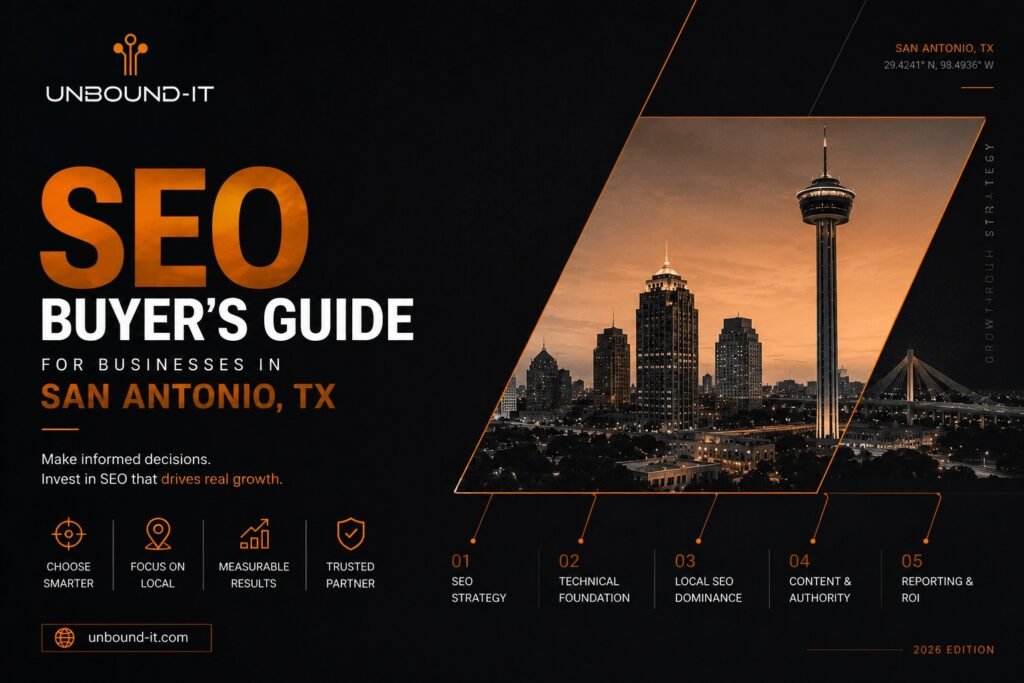
This SEO Buyers’ Guide for Businesses in San Antonio, TX explains what businesses should look for when investing in SEO, how traditional SEO compares with AI SEO and paid search, what local businesses should know about AI-driven search, and how to choose the right SEO and digital marketing partner.
What Is SEO?
Search engine optimization is the process of improving a website and its broader online presence so that search engines and other discovery systems can understand the business and connect it with relevant users.
Traditional SEO still involves technical optimization, keyword research, content, internal linking, backlinks, website performance, and local search optimization.
However, the search environment has expanded.
Google increasingly provides answers directly within search results, while AI-powered search experiences can summarize information from multiple sources and help users explore a topic through follow-up questions.
This does not make traditional SEO irrelevant.
It makes the fundamentals more important.
Search engines and AI systems still need reliable information to understand what a business does, where it operates, which services it provides, and whether its information is trustworthy.
For a business in San Antonio, this means your website should clearly communicate your services, locations, expertise, and value while maintaining a technically strong foundation.
Why SEO Matters for San Antonio Businesses
People use search engines to find businesses at different stages of the buying process.
Someone may search for a general solution to a problem. Another person may compare different services. Someone closer to making a decision may search for a specific company or service in San Antonio.
These searches represent different levels of buying intent.
For example, a person searching for “how to protect a business from ransomware” is researching a problem.
Someone searching for “cybersecurity services San Antonio” is looking for potential providers.
A person searching for “UNBOUND-IT San Antonio” already knows the brand.
A strong SEO strategy considers all three stages.
This is important because not every customer starts with a service keyword. Some customers begin with a question, then research solutions, and only later look for a company.
By creating useful content across the customer journey, a business can build visibility before a potential customer is ready to make contact.
SEO vs. AI SEO: What Is the Difference?
Traditional SEO focuses primarily on improving a website’s visibility in organic search results.
AI SEO expands this approach to include visibility in AI-powered search and answer experiences.
The terminology is still evolving. You may hear terms such as AI SEO, Generative Engine Optimization, or GEO used to describe efforts to improve how a brand is represented in AI-generated responses.
The goal is not simply to “rank in AI.”
AI systems may generate responses by processing information from multiple sources. Depending on the platform and query, the response may reference websites, business information, reviews, publications, directories, and other sources.
This means businesses need a strong and consistent digital presence.
If your website says one thing, your business profiles say something different, and third-party sources provide outdated information, it becomes harder for search systems to understand your business accurately.
AI SEO therefore builds on many traditional SEO principles.
Clear content, strong topical coverage, structured information, credible sources, technical accessibility, brand consistency, and a trustworthy online presence all matter.
What Is AI SEO and Why Does It Matter in 2026?
AI SEO is the process of improving a brand’s digital presence so that it can be better understood and potentially surfaced across AI-powered search and answer experiences.
This does not mean there is a single optimization technique that guarantees a business will appear in ChatGPT, Google AI experiences, or every other AI platform.
There is no universal ranking formula for all AI systems.
Instead, businesses should focus on making their information easy for both people and machines to understand.
For a San Antonio business, this can include clearly explaining the services you provide, maintaining consistent business information, creating detailed service pages, publishing useful original content, demonstrating real expertise, and building a strong presence across relevant and trustworthy sources.
For example, an IT company should not only have a page saying it provides IT services.
It should clearly explain the specific problems it solves, the industries it serves, the technologies it works with, the geographic areas it covers, and the expertise behind its services.
This gives search engines and AI systems more context about the business.
Traditional SEO vs. AI SEO
Traditional SEO and AI SEO are not competing strategies.
They overlap significantly.
Traditional SEO focuses heavily on organic rankings, search visibility, technical performance, keywords, content, and links.
AI SEO places additional emphasis on entity understanding, information consistency, topical authority, conversational queries, structured information, and how a brand is represented in AI-generated answers.
Consider a business that wants to be discovered for “cloud solutions in San Antonio.”
Traditional SEO may focus on creating and optimizing a dedicated service page for that search.
An AI-focused strategy may also consider whether the website clearly explains the company’s cloud capabilities, target customers, use cases, technologies, and expertise.
The traditional SEO approach helps search engines understand the page.
The broader AI SEO approach helps create a more complete understanding of the business.
Both approaches should work together.
How AI Search Is Changing Customer Behavior
AI-powered search is changing how people ask questions.
Instead of typing short keywords, users can ask detailed questions in natural language.
For example, instead of searching only for “cybersecurity San Antonio,” a potential customer might ask:
“What cybersecurity company in San Antonio can help a small business protect its network and data?”
This type of query contains more context.
Businesses should therefore create content that answers real questions rather than writing pages around isolated keywords.
A service page should explain what the service is, who needs it, what problems it solves, how the process works, and what makes the provider qualified.
This is useful for traditional search and AI-powered discovery.
Why Local SEO Still Matters in the Age of AI
The rise of AI search does not eliminate local SEO.
Local businesses still need accurate and consistent information about their location, services, contact details, operating areas, and customer reviews.
For businesses serving San Antonio, local SEO can help connect the company with customers searching for services in the area.
A Google Business Profile remains an important part of local visibility, while website content, reviews, local citations, and other online signals can contribute to a stronger local presence.
AI-powered systems also need reliable information about businesses.
If your business name, address, phone number, services, and operating areas are inconsistent across the web, it may create confusion.
For this reason, local SEO and AI SEO can support each other.
The stronger and more consistent your digital footprint, the easier it is for different systems to understand your business.
What Should a San Antonio Business Look for in an SEO Company?
Choosing an SEO company in San Antonio requires more than comparing monthly packages.
The right provider should understand both traditional search and the changing search environment.
SEO Strategy
A professional SEO strategy should begin with research.
The provider should understand your industry, competitors, customers, target locations, and business objectives before recommending keywords or content.
A strategy for a local service business should not be identical to a strategy for an eCommerce company or a national technology provider.
Technical SEO
Technical SEO remains important in 2026.
Search engines need to access and understand your website efficiently.
An SEO provider should be able to evaluate areas such as website architecture, crawling, indexing, redirects, canonicalization, mobile usability, page experience and Core Web Vitals, performance, and structured data. Tools such as Google PageSpeed Insights can help gauge current performance.
Technical SEO is especially important when launching a new website or rebuilding an existing one.
Content Quality
AI has made content production easier.
That has also created more low-quality content across the web.
Simply publishing hundreds of AI-generated articles is not a sustainable SEO strategy.
Businesses should focus on original, useful, accurate content that demonstrates genuine knowledge and provides information customers cannot easily find elsewhere.
AI can help with research, analysis, and content workflows, but businesses still need human expertise, review, fact-checking, and editorial judgment.
Local SEO
If your business serves customers in San Antonio, your SEO partner should understand local search.
The strategy should reflect your actual service area and should help potential customers understand where you operate.
Location-specific content should provide genuine value instead of creating pages that simply replace one city name with another.
AI SEO and Search Visibility
Ask your SEO provider how they are adapting to AI-powered search.
A good provider should be able to explain how it approaches content structure, entity optimization, topical authority, structured data, brand consistency, and digital visibility.
Be cautious of anyone promising guaranteed placement in AI-generated answers.
No legitimate provider can guarantee that an AI system will mention your business for every relevant query.
How Much Do SEO Services Cost in San Antonio?
SEO pricing varies significantly.
A small local business with a few services may require a smaller campaign than a large company targeting multiple locations and competitive industries.
The cost can depend on the website’s current condition, competition, content requirements, technical complexity, target market, and scope of work.
In 2026, businesses should also consider whether their SEO investment includes preparation for AI-driven search.
This does not necessarily mean paying for a separate “AI SEO package.”
In many cases, strong technical SEO, useful content, structured information, local optimization, and authority building already support both traditional search and AI discovery.
The key is understanding what the provider will actually do.
A business should know whether its investment covers technical SEO, content, local optimization, reporting, strategy, and ongoing improvements. Reach out for a scoped quote before committing to a package.
SEO vs. PPC
SEO and PPC serve different purposes.
SEO focuses on organic visibility and can build long-term search presence.
PPC provides paid visibility and can generate traffic quickly when campaigns are properly managed.
Consider a new San Antonio business that has just launched a website.
SEO may take time to build visibility, especially in a competitive market. PPC can help the business reach potential customers sooner while the SEO strategy develops.
However, PPC requires ongoing advertising spend.
If the campaign stops, the paid traffic generally stops as well.
SEO does not work in the same way. Once a page earns strong organic visibility, it may continue generating traffic without paying for each visit.
This is why many businesses use SEO and PPC together.
Paid search can capture immediate demand, while SEO works toward long-term organic visibility.
SEO vs. AI Search Optimization
AI search introduces a different consideration.
Traditional search often presents a list of links.
AI search may provide a synthesized answer and potentially direct users to selected sources.
This means the objective is no longer only to rank a webpage.
Businesses also need to build a strong digital identity.
An IT company, for example, should clearly communicate its services across its website and relevant online profiles.
The more complete and consistent the information, the easier it is for search systems to understand the organization.
However, businesses should not create content solely to manipulate AI systems.
The best approach is to create content that is genuinely useful to customers while ensuring that the business’s expertise and services are clearly represented.
How Web Design and SEO Work Together
A website is the foundation of most SEO strategies.
If the website is difficult to navigate, slow, poorly structured, or not mobile-friendly, it can create problems for both users and search engines.
This is why web design and development should be considered alongside SEO.
A business may invest heavily in content and backlinks, but if the website has major technical problems, the overall strategy may not perform as expected.
For businesses in San Antonio, choosing a partner that understands both web development and SEO can simplify this process.
The website can be planned with search visibility, user experience, conversion goals, and future growth in mind.
The Role of Structured Data in Modern SEO
Structured data helps search engines understand specific information on a webpage. Most structured data follows the schema.org vocabulary.
Depending on the business and content, structured data may help communicate information about organizations, products, services, articles, FAQs, events, and other entities.
Structured data does not guarantee higher rankings or placement in AI-generated answers.
However, it can provide clearer context about the information presented on a website.
For businesses investing in technical SEO, structured data should be considered where it is relevant and supported by the content on the page.
It should never be used to mark up information that is not actually present or accurate.
How to Measure SEO and AI SEO Performance
Measuring SEO performance in 2026 requires a broader view.
Traditional SEO metrics such as organic traffic, keyword rankings, impressions, clicks, and conversions remain useful.
Businesses should also monitor how organic search contributes to actual business outcomes.
For a service business, this could mean tracking qualified enquiries, phone calls, consultation requests, and lead quality.
AI search measurement is more difficult because visibility may not always be reported in the same way as traditional search.
Businesses can monitor brand mentions, referral traffic from AI platforms where available, branded search growth, and changes in how their business appears across digital channels.
The measurement approach will continue to evolve as AI search develops.
The important point is to avoid relying on one metric.
A business can have strong rankings and still generate poor results if the traffic is irrelevant.
The goal should be visibility that leads to meaningful business activity.
In-House SEO vs. Hiring an SEO Agency
Businesses can manage SEO internally or work with an external agency.
An in-house team offers direct control and close access to the business. However, a complete SEO operation may require multiple skill sets, including technical SEO, content, analytics, development, local SEO, and digital marketing.
An external agency can provide access to a broader team without requiring the business to hire every specialist internally.
The best option depends on the company’s size, resources, budget, and long-term goals.
For many small and mid-sized businesses, working with an experienced agency can provide a practical way to access multiple areas of expertise.
The most important factor is the quality of the strategy and execution.
What Should You Ask Before Hiring an SEO Company?
Before signing an SEO agreement, ask the provider how it will evaluate your website and competitors.
Ask what work will be completed each month and how priorities will be determined.
Ask how the provider approaches AI search and whether it understands the difference between traditional SEO and AI-focused optimization.
Ask how content is created and reviewed.
Ask how backlinks are acquired.
Ask how technical issues are identified and addressed.
Ask which metrics will be included in reports.
Ask who owns the content and website assets created during the campaign.
Ask whether the agency guarantees rankings.
If an agency promises guaranteed first-page rankings or guaranteed mentions in AI-generated answers, treat that as a warning sign.
Search engines and AI systems are constantly changing, and no agency controls their algorithms.
How to Compare SEO Companies in San Antonio
When comparing SEO companies, do not compare only monthly prices.
Compare the actual scope of work.
One provider may offer basic on-page optimization, while another may provide technical SEO, content strategy, local SEO, web development support, digital marketing, and ongoing analysis.
These services are not equivalent.
Look at the provider’s experience, communication, reporting process, technical capabilities, and understanding of your industry.
A strong SEO partner should be able to explain its recommendations in simple terms.
You should understand what is being done, why it matters, and how success will be evaluated.
Why Choose UNBOUND-IT for SEO and Digital Solutions?
UNBOUND-IT provides businesses with a broader range of digital and IT services, including website development and design, mobile app development, digital marketing and SEO, cloud solutions, cybersecurity, and IT recruitment.
This allows businesses to look at digital growth from more than one perspective.
SEO may bring potential customers to a website, but the website needs to provide a strong experience once they arrive.
A business may also need digital marketing to build awareness, cloud solutions to support its operations, or cybersecurity to protect its digital environment.
For San Antonio businesses, this connected approach can help create a stronger digital foundation.
The focus should not be on SEO in isolation.
The goal should be to build a digital presence that is visible, useful, credible, secure, and capable of supporting business growth.
The Future of SEO for San Antonio Businesses
SEO is not disappearing in 2026.
It is expanding.
Google search remains important, but businesses now need to consider a wider discovery environment that includes AI-powered search, conversational queries, local search, voice experiences, social platforms, and other digital channels.
The businesses most prepared for this shift will be those that focus on the fundamentals.
They will maintain technically strong websites.
They will publish useful and accurate content.
They will demonstrate real expertise.
They will keep their business information consistent.
They will build credible digital authority.
They will optimize for customer intent instead of chasing keywords alone.
AI can change how people discover information, but it does not remove the need for trustworthy information.
In fact, as AI-generated content becomes more common, genuine expertise and reliable sources may become even more important.
Final Thoughts: Choosing the Right SEO Partner in San Antonio
Choosing SEO services is a long-term business decision.
The right provider should understand traditional SEO, local search, technical optimization, content strategy, and the changes brought by AI-powered search.
But businesses should also avoid treating AI SEO as a magic solution.
There is no single tactic that guarantees visibility across Google, AI search engines, or conversational platforms.
The strongest strategy is to build a website and digital presence that clearly communicates who you are, what you offer, where you operate, and why customers should trust you.
For a business in San Antonio, that means combining strong technical SEO with useful content, local relevance, credible authority, and a website designed to convert visitors into customers.
UNBOUND-IT helps businesses build and strengthen their digital presence through website development and design, digital marketing and SEO, mobile app development, cloud solutions, cybersecurity, and IT recruitment.
If your business is evaluating SEO services in San Antonio, start by identifying the customers you want to reach and the business outcomes you want to achieve.
Then choose a partner that can build a strategy around those goals.
The future of SEO will continue to change, but the core principle remains the same: help the right people find the right business at the right time with information they can trust.