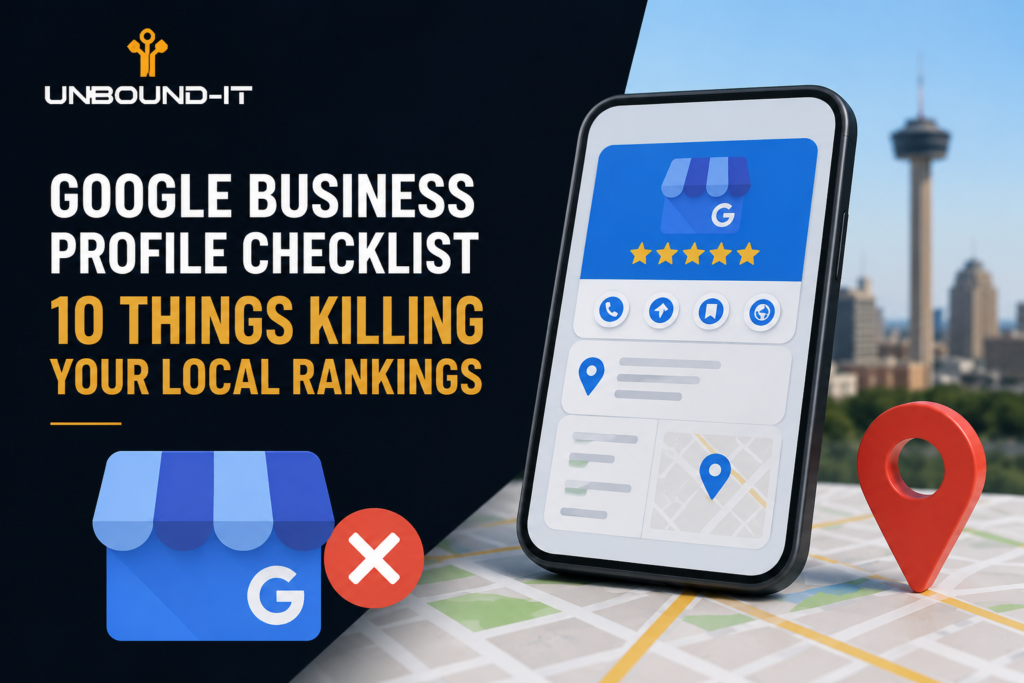
This Google Business Profile checklist exists because most San Antonio business owners are losing local rankings for reasons that have nothing to do with their website, their ad spend, or their competitors doing anything special. The damage is happening inside a profile they set up years ago and have not touched since. If your phone calls have slowed down even though you rank fine on your website, your Google Business Profile is very likely the problem, and it is fixable in a single afternoon of focused work.
Google uses your profile as a primary source of truth for deciding whether to show your business in the Map Pack and whether to mention you in an AI-generated answer. When that profile is incomplete, inconsistent, or neglected, you are not just missing out on extra visibility. You are actively signaling to Google that your business may not be reliable, and that signal gets read by real customers too.
Most business owners assume their profile is fine because it exists and shows up when they search their own business name. That is a false sense of security. A profile can be technically live and still be actively working against you, losing calls to a competitor down the street who simply keeps theirs current. Walking through this checklist with a critical eye, rather than a quick glance, is what separates businesses that fix the problem from ones that keep guessing why their leads have dried up.
Why Your Google Business Profile Matters More Than Your Website Homepage
For a huge share of local searches, your Google Business Profile is the first and only thing a potential customer sees before deciding whether to call. It shows before your website loads, before they scroll past an ad, and often before they read a single review on a third party site. Treating it as a secondary task that gets updated once a year is one of the most expensive mistakes a local business can make.
Google has stated plainly, directly through its own Business Profile guidance, that local rankings come down to three factors: relevance, distance, and prominence. Distance is out of your control. Relevance and prominence are almost entirely shaped by how complete, accurate, and active your profile is. That means the ten items below are not minor housekeeping. They are the actual levers that move your ranking.
The 10 Things Killing Your Local Rankings
Choosing the Wrong Primary Category
Your primary category is the single strongest ranking signal inside your Google Business Profile, a point Google’s own category guidelines make clear. Google uses it to decide which searches your business is even eligible to appear for. A general contractor who selects “Contractor” as their primary category instead of “Kitchen Remodeler” is cutting themselves out of every search where “kitchen remodeler” is the actual term customers type. This mistake alone can suppress visibility more than any other item on this list, and it is one of the fastest to fix. Go into your profile, review the exact category selected, and make sure it matches the highest value service you want to be found for, not just the broadest description of your business.
Secondary categories matter too, but they should never be used to try to rank for services you do not actually offer. Google has become more aggressive about detecting mismatched categories and suspending profiles that appear to be gaming this system. The safer approach is choosing the primary category that most precisely reflects your core service, then adding two or three genuinely relevant secondary categories that expand your reach without stretching the truth.
Inconsistent Business Information Across the Web
Your business name, address, and phone number need to match exactly everywhere they appear online, your website, your GBP, Yelp, Facebook, industry directories, all of it. A phone number that is correct on your website but outdated on three directory listings creates confusion that suppresses your prominence score. This is one of the most common issues we find during an audit, and it usually traces back to old listings created years ago that nobody ever went back to update after an office move or a phone system change.
Even small formatting differences matter more than people expect. Listing your business as “Unbound IT” on one directory and “Unbound IT LLC” on another creates a mismatch that automated systems struggle to reconcile as the same entity. Running a search of your own business name and phone number periodically, and correcting anything that does not match exactly, is one of the highest leverage fixes available because it strengthens every other signal your profile is sending at the same time.
A Thin or Missing Business Description
Google gives you 750 characters to describe your business, and most companies either leave this blank or fill it with vague language about being a trusted partner in excellence. That description should specifically state what you do, who you serve, and the neighborhoods or areas you operate in. Generic language does not help Google match your business to a specific search, and it does not help a customer scanning results decide you are the right fit either.
Photos, Videos, and Posts That Have Not Been Updated in Years
Profiles with recent, high quality photos consistently outperform stale ones, both in ranking and in click through rate. If the only images on your profile are your original logo and a stock photo from your website launch, you are giving Google and your customers nothing to build trust with. This does not need to be elaborate. Recent photos of your team, your completed work, your storefront, or your service vehicles are enough to keep the profile looking active and credible.
The posts feature works the same way and is even more overlooked. It lets you share promotions, recent projects, and updates directly on your listing, and a profile that has not published a post in over a year looks abandoned, even if everything else on it is technically accurate. Regular posts, even short, simple ones about a recent job or a seasonal promotion, signal ongoing activity to Google and give potential customers a reason to trust that your business is actually operating and responsive right now.
Slow or Missing Responses to Reviews
Every unanswered review, especially a negative one, sits on your profile as a visible signal that nobody is managing the account. Responding to reviews, positive and negative, shows both Google and potential customers that your business is actively engaged. A thoughtful response to a negative review often does more to build trust with a new customer than a stack of five star reviews with no owner engagement at all.
Not Generating a Steady Flow of New Reviews
A large batch of reviews from three years ago followed by silence does not carry the same weight as a steady, ongoing stream of recent reviews. Consumer trust research from BrightLocal continues to show that review recency and volume directly shape how much customers trust a listing, and Google’s own ranking model reflects that same pattern for prominence. Businesses that build a simple, repeatable process for asking satisfied customers to leave a review consistently outrank competitors sitting on an old, static review count, even if that competitor technically has more total reviews.
Missing Services and Products Sections
The services section of your profile is one of the most underused tools available to local businesses. Each service you list is an opportunity to add specific, keyword relevant descriptions that help Google match your profile to exact customer searches. A plumbing company that lists only “Plumbing Services” as a single line item is leaving enormous visibility on the table compared to a competitor who lists water heater repair, slab leak detection, and drain cleaning as separate, clearly described services.
Ignoring the Questions and Answers Section
The Q&A section on your profile is public, and if you are not actively monitoring it, anyone, including competitors or people with no real knowledge of your business, can post an answer to a customer’s question. Checking this section regularly and seeding it with a few genuinely useful questions and answers gives you control over the information customers see and gives Google more relevant content to associate with your listing.
Duplicate or Unclaimed Listings
Multiple listings for the same business location split your reviews, your engagement signals, and your ranking authority across two or more profiles instead of consolidating them into one. This often happens after a business changes ownership, moves locations, or gets listed automatically by a data aggregator. Searching for your business name and address periodically to check for duplicates is a five minute task that can resolve a ranking problem that has been quietly costing you visibility for years. Even a single duplicate created by a data aggregator years ago can continue splitting your authority indefinitely if nobody ever goes looking for it, which is why this check needs to happen on a schedule rather than only when something feels obviously wrong.
Never Checking Your Profile Performance Data
Google Business Profile includes performance data showing how customers are finding you, what actions they take, and how your visibility trends over time. Businesses that never look at this data are flying blind, making changes without any way to measure whether those changes actually worked. Reviewing this data monthly, alongside your website analytics, is what separates businesses that are actively improving their local presence from ones that set it up once and hope for the best.
Why This Matters More in a Growing Market Like San Antonio
San Antonio is not a market where local businesses can afford to treat their Google Business Profile as a set it and forget it task. More businesses are investing in their digital presence every year, and the ones getting these fundamentals right are locking in Map Pack positions that become genuinely difficult for competitors to dislodge once review counts and engagement history build up over time. A business that waits another year to fix these ten issues is not just standing still. It is watching a competitor down the street pull further ahead with every review they collect and every search they win in the meantime.
The businesses seeing the strongest results right now are rarely the largest or most established names in their industry. They are the ones paying close, consistent attention to the details most competitors are ignoring.
What Fixing These Actually Does for Your Business
None of these fixes are exotic or require technical expertise. What they require is consistent attention, which is exactly what most business owners do not have time for on top of running daily operations. When these ten issues get corrected, the result is not a vague improvement in visibility. It shows up as more calls from customers who already understand what you offer, better Map Pack positioning against local competitors, and a stronger foundation for the AI-driven search results that are increasingly deciding which local businesses get mentioned at all.
A complete, active Google Business Profile also directly supports the rest of your local search strategy. It reinforces the trust signals your digital marketing and SEO efforts depend on, and it works alongside a fast, well-structured website, the kind measured by Google’s Core Web Vitals standards, to give both Google and AI search systems a consistent, credible picture of your business.
How Long It Takes to See Results
Most of these fixes take effect faster than people expect. Category corrections, description updates, and adding missing services can show measurable ranking movement within a few weeks. Review velocity and photo activity build authority more gradually, typically over sixty to ninety days of consistent effort. The businesses that see the strongest, most lasting results are the ones that treat this as ongoing maintenance rather than a one time cleanup, a pattern Search Engine Journal has documented repeatedly across local search case studies, since Google continues to reward active, regularly updated profiles over static ones.
It also helps to set realistic expectations internally before you start. A profile that has been neglected for several years will not fully recover its authority in a single month, no matter how thorough the cleanup is. What you can expect early on is incremental movement, a slight increase in Map Pack appearances, a small rise in profile views, more calls trickling in from searches you were not showing up for before. That early movement is the signal the fixes are working, and it is what should drive the decision to keep the maintenance going rather than stopping once the initial cleanup is done.
Get Your Google Business Profile Audited
If you are not sure which of these ten issues apply to your business, guessing is not a good strategy when local visibility is on the line. Unbound IT works with businesses across San Antonio to audit Google Business Profiles, fix the issues suppressing local rankings, and build the kind of ongoing review and content strategy that keeps a profile performing month after month. We look at every item on this checklist against your actual listing, compare it against what your closest local competitors are doing, and hand you a clear, prioritized plan instead of a generic report full of jargon.
Learn more about our full range of services, see our approach on our about us page, or contact us to get a straightforward audit of exactly where your profile stands today.
Frequently Asked Questions
How often should I update my Google Business Profile?
At minimum, check it monthly for accuracy and respond to new reviews within a few days of them posting. Photos, service descriptions, and posts should be refreshed regularly enough that the profile never looks abandoned. Businesses that treat this as a weekly five minute task consistently outperform ones that only revisit the profile once a year.
Can a wrong category really hurt my rankings that much?
Yes. Your primary category determines which searches Google considers your business eligible to appear for in the first place. Choosing a category that is too broad or slightly inaccurate can exclude you from the exact searches your ideal customers are running, regardless of how strong the rest of your profile is.
Do I need a certain number of reviews before my profile starts ranking well?
There is no fixed threshold, but consistency matters more than total count. A business with a steady, ongoing stream of recent reviews will often outrank a competitor with more total reviews that stopped growing years ago. Focus on building a repeatable process for requesting reviews rather than chasing a specific number.
What should I do if I find a duplicate listing for my business?
Request that Google merge or remove the duplicate through your Business Profile dashboard. Leaving duplicates in place splits your review count and engagement data across multiple listings, which weakens the ranking authority of your primary profile.
Is fixing my Google Business Profile enough on its own, or do I still need SEO work on my website?
Your profile and your website work together, not separately. A strong profile without a fast, well-structured website behind it will still lose customers once they click through. Both need to be treated as part of the same local visibility strategy rather than two unrelated projects.